
Design targets before choosing equipment
A koi filter is a life-support system. Start with the fish load, feeding level, pond volume, and maintenance access, then choose equipment. A common koi-pond design goal is to move the pond volume through filtration about once every 1-2 hours, with heavier stocking or warm climates leaning toward the faster end.
| Design item | Practical target | Why it matters |
|---|---|---|
| Turnover rate | About 1 pond volume every 1-2 hours for many koi ponds | Koi produce heavy waste; slow circulation leaves solids and ammonia pressure in the pond. |
| Mechanical stage | Remove solids before they break down | Fish waste and uneaten food become ammonia and fine sludge if trapped in the system. |
| Biological stage | Large protected surface area with oxygen-rich flow | Nitrifying bacteria convert ammonia to nitrite and then nitrate, but they need oxygen and stable pH/KH. |
| Aeration | Monitor dissolved oxygen and fish behavior, especially near dawn and during hot weather | Biofilters consume oxygen too; temperature, stocking, feeding, algae, and organic decay all change demand. |
| Cleaning access | Valves, drains, baskets, and media reachable without dismantling the pond | A filter that is difficult to clean will be cleaned less often, which slowly lowers water quality. |
Best-practice filter order
A koi system is easier to understand as a chain. First collect waste from the pond, then remove solids, then run water through biological media, then polish with UV if needed, then return oxygen-rich water to the pond. Do not ask one piece of equipment to do every job.
| Stage | Common equipment | What it does | What it does not do |
|---|---|---|---|
| Collection | Bottom drain, skimmer, mid-water pickup | Moves sinking waste and floating debris toward filtration. | Does not treat ammonia by itself. |
| Mechanical filtration | Rotary drum filter, sieve, settlement chamber, brushes, filter mat, bead filter pre-stage | Removes feces, food, leaves, and suspended solids before they rot. | Does not replace mature bio-media. |
| Biological filtration | Moving bed, shower/trickle tower, Japanese matting, ceramic media, bead media | Supports nitrifying bacteria that process ammonia and nitrite. | Does not remove large solids well if used without prefiltering. |
| Polishing | UV clarifier, fine mat, sand/glass or bead polishing stage | Improves water clarity and controls green-water algae. | Does not fix overstocking, ammonia, or poor solids removal. |
| Return and oxygen | Air diffusers, waterfall, shower return, tangential pond returns | Adds oxygen, moves water, and prevents dead zones. | Does not remove waste unless paired with correct flow paths. |
Mechanical filtration: remove waste early
Mechanical filtration is the first serious line of defense in a koi pond. It should catch solids before they dissolve into ammonia, nitrate, yellow water, sludge, and bacterial load. A cleanable mechanical stage also protects the biological filter from clogging.
| Mechanical option | Strength | Weakness | Best fit |
|---|---|---|---|
| Rotary drum filter / RDF / 转鼓过滤 | Automatic fine-screen solids removal; very consistent water clarity; excellent before moving bed or shower filters. | Higher cost, needs water supply for rinse, waste drain, reliable power, and occasional screen/sensor maintenance. | Dedicated koi ponds, high feeding, large collections, owners who want less manual cleaning. |
| Sieve filter | Simple gravity-fed solids removal with no electronics in many designs. | Requires manual rinsing; does not catch fines as consistently as RDF. | Medium koi ponds where owner can clean frequently. |
| Settlement chamber | Low-tech and gentle; useful with bottom drains if sized large enough. | Needs space; poor at fine suspended solids without follow-up filtration. | Traditional gravity-fed systems and DIY ponds with room. |
| Brushes and matting | Cheap and easy to understand. | Can become sludge traps if not flushed often; messy maintenance. | Budget systems, quarantine systems, or as secondary capture. |
| Bead/pressure filter as mechanical stage | Compact, pressurized, can polish water. | Backwashing must be regular; can channel or clog under heavy waste. | Small to medium ponds when paired with good prefiltering. |
Real Equipment Video
Watch: rotary drum filter basics
This video shows the RDF idea clearly: a fine screen catches solids, the drum rotates, spray nozzles wash the screen, and waste exits before it can decay in the system.
Biological filtration: choose media by oxygen, flow, and cleaning style
Biological filtration is where bacteria convert ammonia to nitrite and nitrite to nitrate. Media choice matters, but flow, oxygen, KH stability, and keeping solids out of the bio chamber matter just as much. A clogged bio chamber becomes a waste tank instead of a life-support system.
| Bio option | How it works | When it shines | Design cautions |
|---|---|---|---|
| Moving bed / floating media / K1-style media | Small buoyant media churns in an aerated chamber, constantly exposing biofilm to oxygen and ammonia-rich water. | Stable ammonia/nitrite control, self-cleaning media motion, easy expansion. | Needs strong air, enough chamber volume, screens to retain media, and prefiltered water. |
| Shower filter / trickle tower / Bakki-style shower | Water falls through media in open air, giving bacteria high oxygen and improving gas exchange. | Heavy feeding, warm water, strong bio performance, oxygen support. | Can be noisy, visible, cooling in winter, and should receive mechanically clean water. |
| Japanese matting | Sheets of mat provide large protected surfaces and can be arranged in chambers. | Traditional multi-bay filters and stable gravity-fed systems. | Needs periodic gentle cleaning; can trap solids if mechanical stage is weak. |
| Ceramic or sintered glass media | High surface-area media used in showers or submerged chambers. | Compact bio capacity and strong shower performance. | Brittle media and pores can clog if solids are not removed first. |
| Bead media | Pressurized plastic beads provide mechanical polishing and bio surface. | Compact installations where gravity bays are not possible. | Requires correct backwash and enough oxygen; avoid relying on it as the only bio stage for heavy loads. |
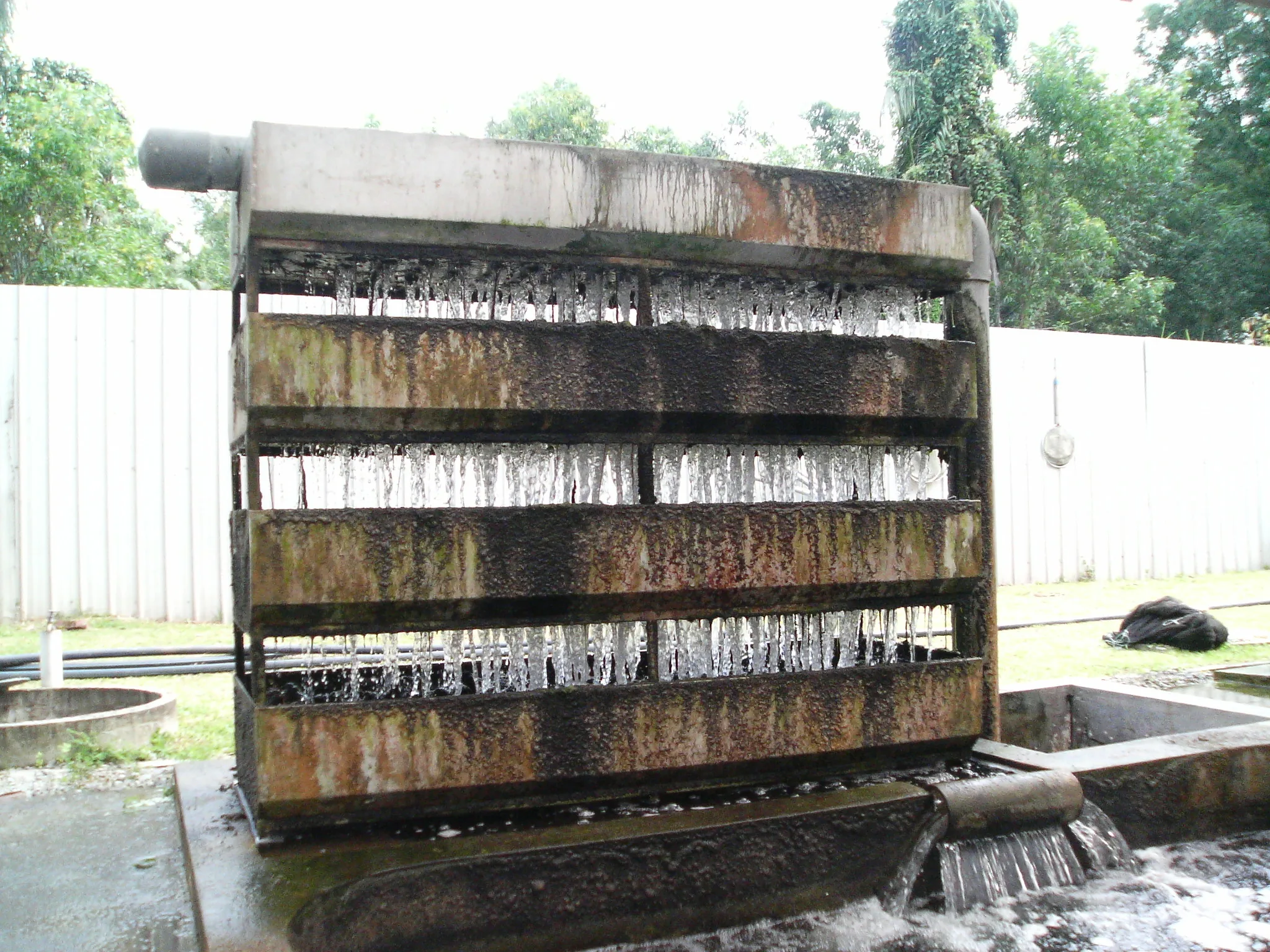
Real Equipment Video
Watch: moving bed biological filtration
Moving bed filters are often what people mean by a floating-bed biological chamber: buoyant media is kept in motion by air, giving nitrifying bacteria oxygen and constant contact with pond water.
Real Equipment Video
Watch: shower and trickle filtration
Shower and trickle filters are useful because they combine biofiltration with gas exchange. They work best after strong mechanical filtration, not as a place to collect leaves and feces.
UV clarifier: what it really does
A UV clarifier exposes water to ultraviolet light, damaging free-floating algae cells so green water clears. It is most useful for pea-soup algae, not for string algae on rocks, ammonia, nitrite, sludge, or parasites already attached to fish. Put UV after mechanical filtration so the water is clearer before it reaches the lamp, and use a bypass or valve so flow can match the unit's rating.
- Benefits: clearer green water, better fish observation, less suspended-algae bloom pressure, and easier inspection for ulcers or behavior changes.
- Limits: UV does not remove waste; it does not replace a biofilter; old bulbs still glow but may lose effective UV output.
- Maintenance: clean the quartz sleeve, replace bulbs on schedule, protect eyes from UV exposure, and turn off power before service.
Equipment Video
Watch: UV clarifier purpose
This UV clarifier video is useful for beginners because it separates green-water control from true filtration. UV improves clarity; the filter still has to remove solids and process ammonia.
Do you need extra aeration?
For koi, the practical answer is usually yes. Waterfalls help, but they are not a substitute for dedicated air in many koi ponds. Air supports fish, nitrifying bacteria, moving-bed media, and emergency resilience. Add more air during hot weather, after heavy feeding, during medication, and during algae die-off.
Monitor oxygen by time, trend, and fish behavior
A single dissolved-oxygen number cannot describe every koi pond. Water temperature changes how much oxygen water can hold, while fish load, feeding, algae, decaying material, and biofilters change how quickly it is consumed. Measure at repeatable locations and times; a pre-dawn reading is especially useful because nighttime respiration can leave oxygen lowest around sunrise.
- Record context: note water temperature, time, recent weather, feeding, and where the sample was taken so readings can be compared.
- Watch the fish: fish gathering at the surface or crowding a return near sunrise is an urgent warning, not a reason to wait for another test.
- Respond safely: start backup air or another known aeration method, stop feeding while the pond is unstable, confirm pumps and filters are running, and investigate algae die-off, excess organic matter, or circulation failure.
- Plan resilience: keep a tested backup air pump or power plan for warm nights and outages; decorative fountains may move too little water to protect a heavily stocked koi pond.
| Aeration point | Why use it | Placement note |
|---|---|---|
| Air diffuser on bottom drain | Lifts water, improves circulation, supports oxygen, and helps solids move toward the drain. | Use a diffuser designed for pond depth and match it to the air pump. |
| Moving bed air manifold | Keeps floating media boiling and oxygenated. | Too little air causes dead media zones; too much can push media into screens. |
| Air stones in quarantine or hospital tank | Medication and warm water often reduce oxygen margin. | Use dedicated equipment for quarantine to avoid cross-contamination. |
| Backup air pump | Protects fish during pump/filter failure. | Battery backup or generator planning matters in storm-prone areas. |
Pump head and real delivered flow
A pump's headline flow is not the flow that reaches the pond after water climbs to a waterfall and passes through pipework, valves, filters, and a UV unit. Select a pump from its performance curve at the system's estimated total dynamic head (TDH), not from its maximum-flow number.
| Part of the calculation | What to include | Why it matters |
|---|---|---|
| Static head | The vertical difference between the source water level and the highest discharge or open return. | Every foot or metre of lift reduces the flow a pump can deliver. |
| Pipe friction | Pipe length and diameter, flow velocity, pipe material, elbows, tees, valves, and reducers. | Small pipe and many fittings can consume more head than the visible lift. |
| Equipment resistance | Pressurised filters, UV units, heaters, check valves, and other inline devices. | Use manufacturer loss data when available; a clean-filter estimate is not the worst case. |
A practical pump-selection workflow
- Set the required circuit flow. Base it on filter and UV operating ranges, fish load, aeration plan, and the job of that circuit. There is no single turnover number that fits every koi pond.
- Sketch the entire route. Record pipe diameter and length, vertical lift, and every fitting and device from intake to return.
- Estimate TDH. Add static head to friction and equipment losses. Simple rules of thumb are only preliminary estimates.
- Read the pump curve. Find the flow where the estimated head intersects the manufacturer's curve. Avoid choosing by the zero-head or maximum-flow label.
- Verify after installation. Use a correctly sized inline flow meter, or safely time a measured outlet where practical. For a timed container test:
gallons collected × 3,600 ÷ seconds = gph. - Recheck under real conditions. Measure again after filters begin to load; falling flow can reveal dirty screens, blocked strainers, air leaks, or a restricted line.
Keep gravity-fed and pump-fed circuits separate when calculating head. A gravity transfer pipe and a pressurised return line do not behave as one continuous pump curve.
Example system layouts
| Pond type | Good filtration chain | Comments |
|---|---|---|
| Dedicated koi pond | Bottom drain + skimmer -> RDF or sieve -> moving bed -> shower/trickle -> UV bypass -> returns + air | Strong, cleanable, and scalable. Highest upfront cost but easiest to keep stable under real koi load. |
| Medium garden pond with koi | Skimmer + retro bottom drain -> sieve or settlement -> matting/moving bed -> UV -> waterfall return | Works if stocking is conservative and plants/rocks do not trap waste. |
| Small raised formal pond | Bottom pickup/skimmer -> compact sieve or pressure prefilter -> moving bed or bead + UV -> returns | Watch temperature swings and oxygen. Avoid overstocking just because water looks clear. |
| Quarantine tank | Covered tank -> sponge or mature media filter -> air stone -> easy water-change access | Simple, testable, and separate from main-pond equipment. |
Filter sizing mistakes
- Buying a filter rated for a lightly stocked garden pond and using it on a heavily stocked koi pond.
- Letting solids reach the bio chamber, then wondering why ammonia and sludge rise.
- Counting a UV clarifier as filtration. UV can clear green water, but it does not remove ammonia or solids.
- Cleaning biological media with chlorinated tap water or cleaning all media at once.
- Ignoring head height, pipe diameter, elbows, and UV restrictions, so real flow is far below the pump label.
- Leaving no waste drain, bypass, unions, or valves for maintenance.
- Skipping extra aeration because a waterfall looks active.
Source notes
Pump-selection principles were cross-checked against Penn State Extension, which notes that required pump flow depends on pond volume, travel distance and height, and filtration; Aquascape's head-height guide, which separates static lift from plumbing resistance; and Pentair Aquatic Eco-Systems pump curves, which plot delivered flow against total dynamic head. Oxygen-risk guidance was checked against Mississippi State University Extension's fish-kill guidance, which identifies surface gasping near sunrise as an early low-oxygen warning, and its summer aeration guidance, which explains that warmer water holds less oxygen. These are general pond-management sources, so the page uses them for monitoring principles rather than claiming a universal koi threshold.