
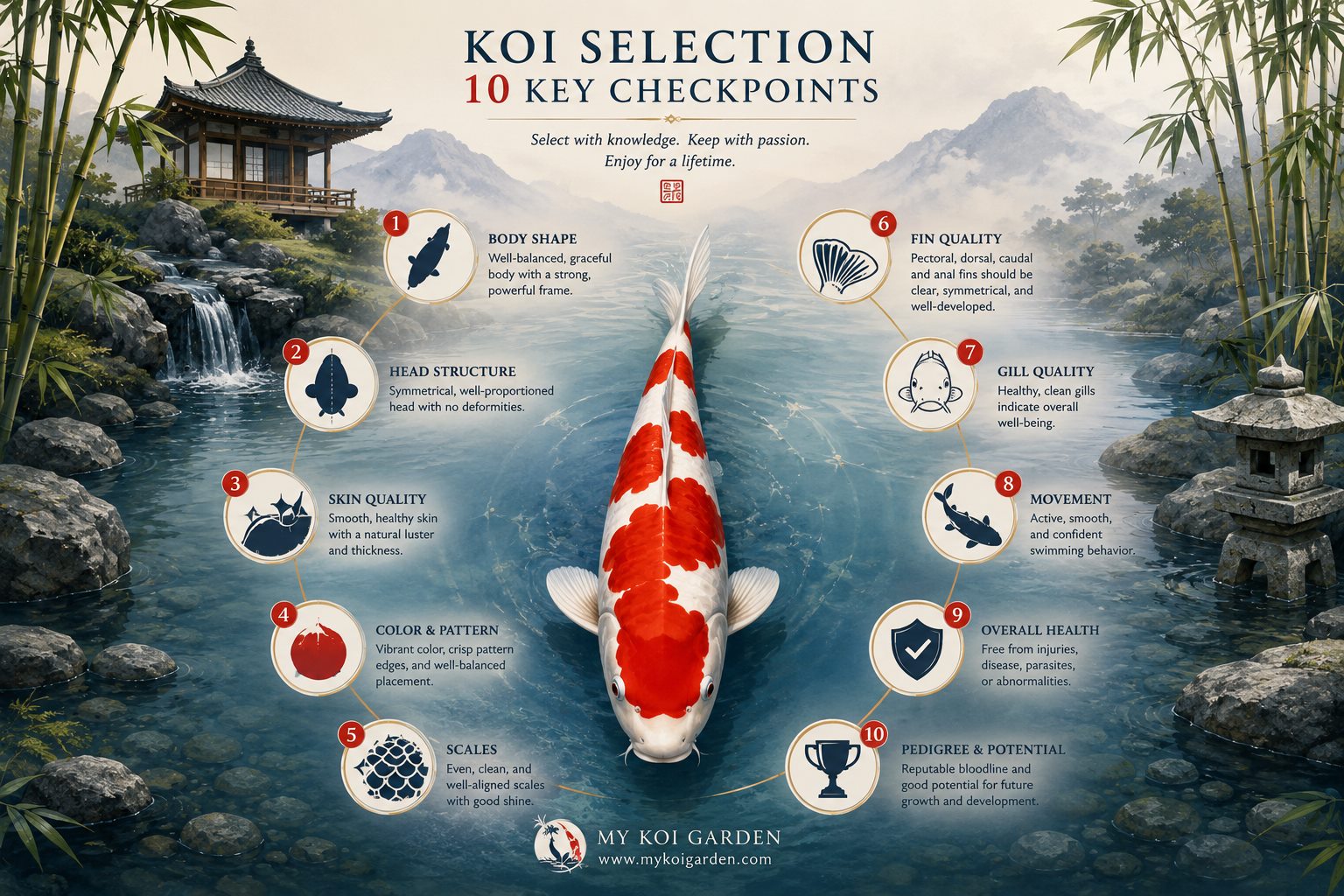
Look at behavior first
A healthy koi should swim steadily, respond to its surroundings, and avoid gasping, clamped fins, isolation, uncontrolled rolling, or repeated flashing. Watch for at least 3-5 minutes instead of judging from a single photo. If several fish in the tank are breathing hard, the issue may be water quality or oxygen, not one weak fish.
| Observation | Healthy sign | Warning sign |
|---|---|---|
| Breathing | Even gill movement, not crowding the surface | Rapid breathing, piping, hanging under returns or waterfalls |
| Swimming | Level body, smooth turns, responsive but not frantic | Head-down posture, rolling, scraping, loss of balance |
| Fins | Open and relaxed while cruising | Clamped fins, split fins, red fin bases, damaged long fins |
| Appetite | Interested in food when the group is fed | One fish refuses food while others eat normally |
Use a repeatable selection workflow
A professional selection process is deliberately slow. First decide what you are trying to buy: variety, size range, budget, pond space, and whether you want a finished-looking koi or a younger fish with development potential. Then make a first pass from a distance, bowl only the koi worth closer study, and review each fish again under calmer conditions before asking for a final price.
| Step | What to do | Why it matters |
|---|---|---|
| Set the target | Write down variety, size, budget, and must-have traits before looking. | It prevents buying the most dramatic fish instead of the right fish. |
| First pass | Watch the group and mark candidates by health, body, and overall presence. | The best fish usually still look balanced before they are isolated. |
| Bowl review | View top-down in clean water; compare body, scales, fins, skin, and pattern. | Small flaws become easier to see when the koi slows down. |
| Second look | Put back fish with deal-breaker flaws, even if one feature is attractive. | A beautiful pattern cannot fix weak conformation, damaged fins, or poor skin. |
| Record and plan | Record seller, breeder if known, size, sex if known, price, and transport/quarantine plan. | Good records protect the fish and make later decisions more honest. |
For expensive koi, compare quality against price after the fish is bowled, not before. A flaw can be acceptable if the price reflects it and you knowingly accept the risk; it is not acceptable if the flaw is hidden, ignored, or likely to worsen.
Scales, fins, color, and pattern need separate checks
After health and body, separate the visual details instead of judging them all as one impression. Standard scales should look soft and even. Gin Rin should sparkle consistently rather than appearing scattered only in a few random spots. Doitsu koi should have clean skin and intentional scale placement. Fins should match in size, shape, and cleanliness; one deformed or badly damaged fin can change the whole value of the fish.
Color quality is not just brightness. In solid-colored koi, the color should remain consistent from head toward tail. In patterned koi, look for clean color separation, strong shiroji, even beni, and sumi that looks intentional for the variety. Kiwa, the trailing edge where one color ends, should be crisp on mature areas; young koi may show softer leading edges as color develops, but muddy color everywhere is a warning sign.
Age changes the certainty of your judgment. Tosai and very small koi are a gamble: they can change dramatically, so buy them for learning, value, or trusted breeder lines, not because you think you can predict everything. Two- and three-year-old koi usually give a clearer picture of body, skin, sex tendency, and future direction, but they also cost more.
Body shape matters
Choose a koi with a smooth body line, balanced shoulders, and no visible bends or deformities. From above, the body should look symmetrical from head to tail. The tail tube should not be pinched, because weak tail structure often makes the fish look less powerful as it grows.
- Check the spine line from nose to tail; avoid kinks, S-curves, and uneven shoulders.
- Look for a broad but balanced head, not a sharp skinny head attached to a round body.
- For young koi, avoid choosing only by pattern; body potential often matters more over time.
- For larger koi, look for volume through the shoulders and a clean taper into the tail tube.
A four-part judging lens
The All Japan Nishikigoi Promotion Association summarizes show evaluation in four broad areas. Use them as a viewing order, not as a universal percentage formula:
| Area | What it means | Practical check |
|---|---|---|
| Body conformation | Shape, symmetry, frame, and balanced volume from head through the tail tube. | View the whole fish from above before becoming absorbed by color or pattern. Body is generally the most heavily emphasized area, especially in larger adult koi. |
| Quality | Clarity, depth, and evenness of skin and color. | Look for clean white, substantial red, strong black, and consistent color rather than isolated bright patches. |
| Finish / condition | How well the koi presents at that time, including luster and the freshness of its colors and white ground. | Do not confuse temporary poor condition with pattern identity, or assume one photograph can prove show-day finish. |
| Pattern | The placement and balance of markings. | Pattern is important, but preference varies and an attractive pattern cannot compensate for weak conformation or poor skin. |
The four areas are a framework rather than a fixed scoring formula. Their relative importance changes with fish size, condition, variety, and the rules of a particular show.
Professional Video
Watch: selecting for conformation
Sacramento Koi's conformation lesson is a good companion to the buying checklist because it trains the eye away from impulse pattern buying and toward body structure first.
Skin and color
Clear skin, even color, and a fresh surface impression are important. White skin should look bright rather than yellowed or gray. Red should look even and well consolidated for the fish's age. Black should look intentional and deep, not like dirt, bruising, or random peppering unless the variety normally develops that way.
| Feature | What to check | Common mistake |
|---|---|---|
| Shiroji white skin | Brightness, cleanliness, no yellow cast | Ignoring dull skin because the red pattern is exciting |
| Beni red pattern | Even tone, pleasing placement, clean edges for the variety | Buying unstable-looking red that already appears thin or broken |
| Sumi black marking | Depth, balance, correct placement for Sanke/Showa/Utsuri/Bekko | Confusing dirty speckling with quality sumi |
| Surface condition | No ulcers, raised scales, cotton growth, cloudy eyes, or excess mucus | Assuming small wounds will heal in poor quarantine water |
Adjust the checklist by variety
The same five checks apply to every koi, but the emphasis changes by variety. A Kohaku is unforgiving because there is no sumi or metallic shine to distract from skin, body, and beni. A Showa needs black structure in the right places. A metallic koi must be judged by even luster as much as by pattern. Use the table below as a second pass after the fish has already passed health and body checks.
| Variety or type | Prioritize | Be careful of |
|---|---|---|
| Kohaku | Clean shiroji, even beni, strong body, and pleasing pattern rhythm such as two-step, three-step, four-step, inazuma, or sakura-style markings. | Yellowed white, thin or breaking red, messy kiwa, or a pattern that looks exciting only from one angle. |
| Taisho Sanke | Kohaku-quality base first, then sumi placed as accents on the body. The head is usually cleaner than Showa. | Too much head sumi, dirty speckling, or black that distracts from the red-and-white base. |
| Showa | Strong body, Kohaku-like red-and-white pattern underneath, sumi that wraps or bands through the body, and balanced black at the pectoral-fin bases. | Weak tail tube, messy sumi, or black that may overwhelm the fish instead of building contrast. |
| Goshiki | Deep even red, clean fins, attractive face, and a reticulated gray/black netting that is defined but not muddy. | Thin male body if you want jumbo growth, dirty head, or netting that makes the beni look dull. |
| Ogon, Yamabuki, Platinum | Uniform metallic luster from head to tail, consistent color, clean head, and matching fins. | Patchy shine, head color that differs from the body, yellowing on platinum, or messy fin color. |
| Matsuba and Kujaku | Uniform scale reticulation, bright ground color, clean nose, and fins that do not look stained or busy. | Uneven scalation, orange or yellow showing where it should not, messy nose, or distracting dark spots. |
| Tancho | A centered, clean, round head mark supported by good body and skin. In Tancho Sanke, Showa, Goshiki, or Kujaku, the base variety still matters. | Extra red on the nose or body, dark head, off-center mark, or flaws priced as if they do not matter. |
| Doitsu and dragon-scale types | Clean skin, sharp color separation, and intentional rows or lines of large scales. | Random scale placement, rough skin, or color boundaries that look blurred rather than designed. |
| Longfin / butterfly koi | Graceful fin shape, symmetry, intact fin edges, and a body that still looks koi-like rather than weak. | Split, twisted, short, mismatched, or ragged fins. In longfin koi, fins are part of the main value. |
A useful buyer rule is to name the reason before you buy: “I am buying this Kohaku for skin and body,” or “I am buying this Kujaku for clean reticulation and luster.” If you cannot name the reason, you may only be reacting to novelty.
Ask the seller
- How long has the fish been in their care, and was it imported recently?
- Was it quarantined or observed before sale, and for how many weeks?
- What water temperature, pH, and food has it been used to?
- Can they show clear top-view video in a blue bowl, not only edited photos?
- Has it ever been treated for parasites, ulcers, or transport stress?
- What size is it now, and what age estimate or breeder information is available?
Buying decision rule
For a first koi, buy the healthiest fish you can honestly understand, not the most dramatic fish in the tank. If the water, body line, behavior, quarantine history, or seller information is unclear, walk away. Missing one purchase is far cheaper than bringing parasites or bacterial trouble into your pond.
References
General show-evaluation guidance follows the All Japan Nishikigoi Promotion Association examination criteria.
- Merck Veterinary Manual: Routine Health Care of Fish
- All Japan Nishikigoi Promotion Association: Nishikigoi Varieties
- Zen Nippon Airinkai: Varieties of Nishikigoi
- Research note: Sacramento Koi selection-process transcript supplied in the My Koi Garden research library.