
Award-winning reference photos
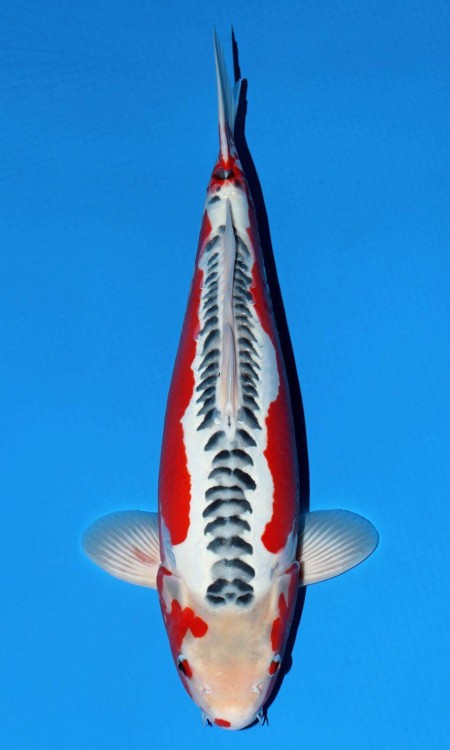
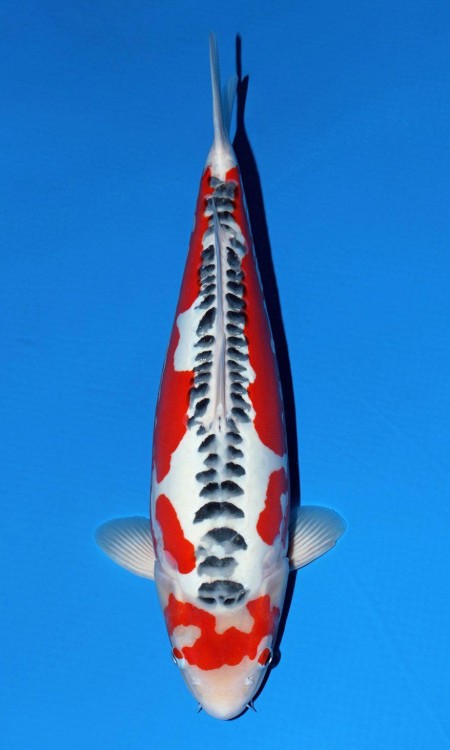
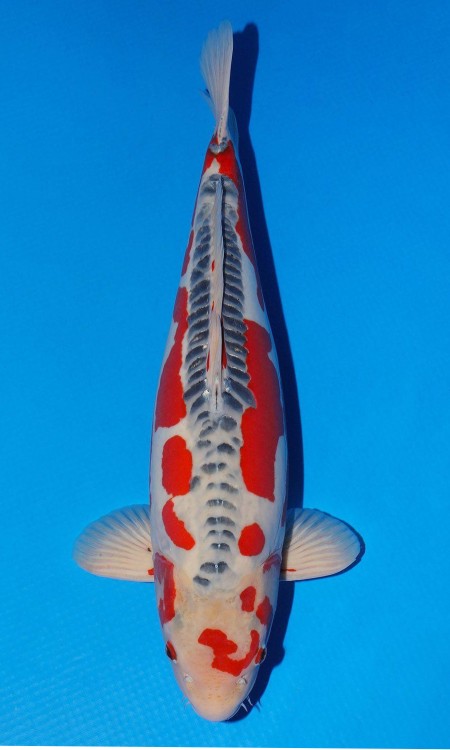
How to identify Doitsu
- Smooth skin with few regular scales.
- Mirror scales may run along the dorsal line or lateral line.
- Can appear as Doitsu Kohaku, Doitsu Sanke, Shusui, and many other forms.
Quality points
- Scale rows should be neat and intentional, not messy.
- Smooth exposed skin makes scars, uneven color, and body faults easier to see.
- JNPA highlights clear kiwa—the boundary between exposed ground color and pattern—as an important Doitsu quality point.
- The fish still needs the correct pattern and quality for its base variety.
Base variety first, scale type second
Doitsu describes scale type rather than a color pattern. Official JAS examples include Doitsu Kohaku, Doitsu Taisho Sanke, Doitsu Showa, Doitsu Shiro Utsuri, Doitsu Goshiki, and Doitsu Ochiba Shigure. Identify the underlying variety first, then add the Doitsu scale modifier.
“Scaleless” is useful shorthand, but not a complete description: most of the body is exposed skin, while larger scales may remain along the back and sides.
Doitsu scale morphology
“Doitsu” does not always mean a perfectly scaleless fish. Historical Japanese association material distinguishes several scale expressions, while the current JAS definition keeps them within the broader Doitsugoi category.
| Morphology term | What it describes | Classification caution |
|---|---|---|
| Mirror-scaled | Large residual scales, commonly arranged along the back or sides of an otherwise exposed body. | Judge the location, row regularity, and consistency of the remaining scales—not scale count alone. |
| Leather-type | A nearly scaleless expression with extensive exposed skin. | Clean skin, color boundaries, and the underlying variety remain important. |
| Armor-type | An intermediate expression with heavier or irregular scale coverage. | This is morphology terminology, not three separate modern JAS show classes. |
Officially documented combinations
JNPA’s current Doitsugoi guide confirms that the scale type appears across many established identities:
- Gosanke and black-pattern families: Doitsu Kohaku, Doitsu Taisho Sanke, Doitsu Showa Sanshoku, Doitsu Shiro Utsuri, Doitsu Hi Utsuri, Doitsu Ki Utsuri, Doitsu Shiro Bekko, and Doitsu Aka Bekko.
- Reticulated and patterned families: Doitsu Goshiki, Doitsu Ochiba Shigure, Doitsu Ai-goromo, and Doitsu Budo-goromo.
- Single-color and Kawarigoi examples: Doitsu Midorigoi, Doitsu Kigoi, Doitsu Chagoi, Doitsu Karashigoi, and Doitsu Karasugoi.
These are verified combinations, not evidence that every imaginable base variety and modifier pairing has an established official name.
When a composition has a recognized name
Do not create a variety name by simply joining “Doitsu,” “metallic,” and a base variety. Several combinations already have established names:
| Recognized name | Appearance composition | Identification cue |
|---|---|---|
| Sakura Ogon / Platinum Kohaku | Kohaku appearance + whole-body metallic luster | A scaled metallic red-and-white identity; Platinum Kohaku is an alternate name, not a separate phenotype. |
| Kikusui | Doitsu body + Kohaku appearance + whole-body metallic luster | Exposed skin and red-and-white Kohaku-style pattern, with luster across the body rather than isolated reflective scales. |
| Yamatonishiki | Taisho Sanke appearance + whole-body metallic luster | The scaled metallic Sanke identity; compare scale type before moving to the Doitsu name. |
| Doitsu Yamatonishiki / Heisei Nishiki | Doitsu body + Taisho Sanke appearance + whole-body metallic luster | White, red, and black Sanke-style pattern on exposed Doitsu skin, with metallic shine. Heisei Nishiki is an established alternate name. |
| Hariwake Ogon | Scaled white body + golden markings + whole-body metallic luster | Regular scales distinguish the base Hariwake identity from its Doitsu counterpart. |
| Doitsu Hariwake Ogon | Doitsu body + Hariwake Ogon appearance | Exposed Doitsu skin with the metallic white-and-gold pattern character of Hariwake. |
| Kumonryu | Doitsu body + black-and-white, cloud-like pattern | The sumi may change as the fish grows or its environment changes, so identify the structure rather than one frozen pattern. |
| Beni Kumonryu | Kumonryu appearance + red markings | Red is added to the non-metallic Kumonryu identity; whole-body metallic luster is not required. |
| Kikokuryu | Metallic luster + Kumonryu appearance | Metallic Doitsu-type black-and-white appearance; the current black pattern should not be assumed to remain fixed for life. |
| Beni Kikokuryu | Kikokuryu appearance + red markings | Red pattern is added to the metallic Kikokuryu identity. |
| Kin Kikokuryu | Kikokuryu appearance + golden markings | Golden markings distinguish it from the red-marked Beni Kikokuryu. |
| Kinsui | Whole-body metallic luster + Shusui appearance | Retains the recognizable Shusui identity while adding overall metallic shine. |
Name-tree shortcut: Kumonryu is the Doitsu black-and-white base. Add red and it becomes Beni Kumonryu; add whole-body metallic luster and it becomes Kikokuryu. From Kikokuryu, red markings indicate Beni Kikokuryu and golden markings indicate Kin Kikokuryu. “Kin” describes the golden pattern, not merely stronger shine.
Classification caution: JNPA’s current directory places Kikokuryu in Kawarigoi while also tagging it for Doitsugoi and Hikarimono traits. A phenotype tag, an official JAS variety class, and a competition-specific show class are related but not interchangeable; use the rules of the event being entered.
Ginrin is different: Ginrin describes gold or silver reflection from individual scales. The names above depend on whole-body metallic luster and a recognized underlying appearance.
Common comparison
Doitsu is a cross-cutting scale type, while Shusui is a named variety that combines Doitsu scale type with Asagi ancestry and characteristic color placement.
| Look first at | Good sign | Beginner caution |
|---|---|---|
| Body | Balanced frame, smooth swimming, no deformity. | Do not let rare color hide weak conformation. |
| Skin and color | Clean, readable, and consistent for the variety. | Muddy color usually becomes more distracting with size. |
| Scale or luster trait | Even rows, sparkle, reticulation, or metallic quality depending on the group. | Random patches, dull fins, or broken scale rows reduce impression. |
Sources
This page follows the All Japan Nishikigoi Promotion Association Doitsugoi definition and association history material on German carp scale morphology. The morphology terms describe scale expression; they are not presented here as separate JAS show classes. Recognized metallic combinations follow the association’s Hikarimono directory; the Kumonryu and Beni Kumonryu distinction follows its Kumonryu standard. Reference photographs are credited individually above.