
Award-winning reference photos
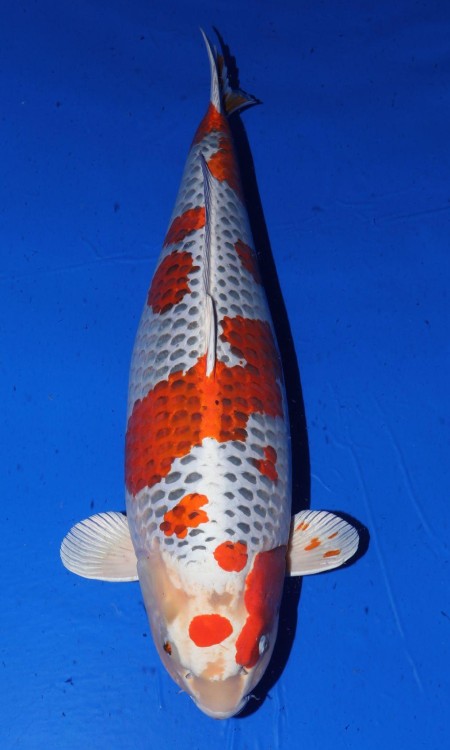
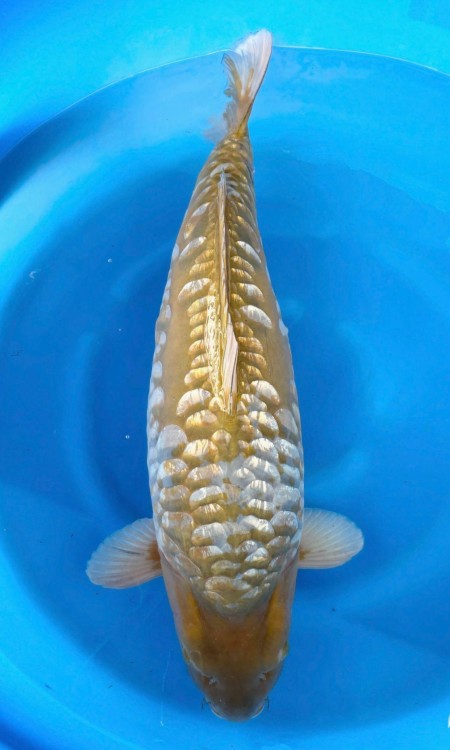
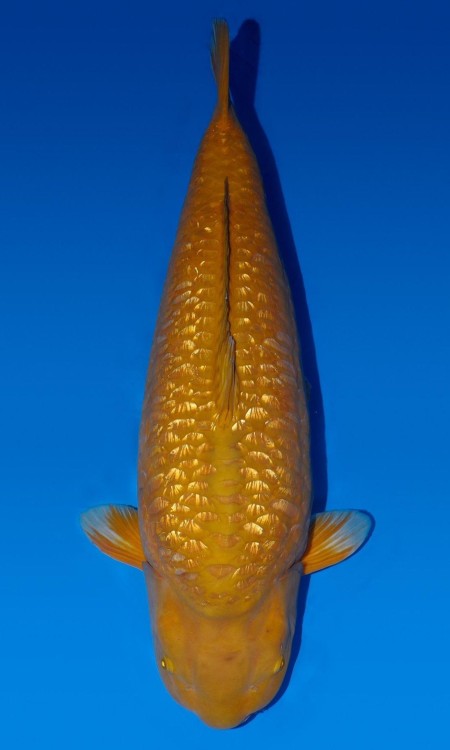
How to identify Gin Rin
- Individual scales reflect light like glass, pearl, or diamond flakes.
- The effect should be visible in rows across the body, not just a few random scales.
- Gin Rin may appear on Kohaku, Showa, Chagoi, and many other varieties.
Quality points
- Sparkle should be even and strong from shoulder toward tail.
- Body and underlying variety quality still come first.
- Avoid fish where the shine is patchy or distracts from weak conformation.
How the official groups fit together
JAS uses A-Ginrin for shining-scale Gosanke—Kohaku, Taisho Sanke, and Showa—and B-Ginrin for shining-scale koi outside those three. These are classification groups; the fish still retains its underlying variety.
- Diamond Ginrin: the strongest, bright reflective effect.
- Pearl Ginrin: a round gold or silver highlight appears near the center of each affected scale.
Common comparison
Compare Gin Rin with metallic Hikari. Gin Rin shine comes from individual scales; Hikari luster is a metallic sheen across the skin and fins. A koi can combine modifiers, so identify each trait separately.
| Look first at | Good sign | Beginner caution |
|---|---|---|
| Body | Balanced frame, smooth swimming, no deformity. | Do not let rare color hide weak conformation. |
| Skin and color | Clean, readable, and consistent for the variety. | Muddy color usually becomes more distracting with size. |
| Scale or luster trait | Even rows, sparkle, reticulation, or metallic quality depending on the group. | Random patches, dull fins, or broken scale rows reduce impression. |
Sources and editorial note
This page follows the official JAS distinction between A-Ginrin and B-Ginrin, while treating Gin Rin as a shining-scale trait layered on an underlying variety. Photos are limited to real images with source and license notes.