
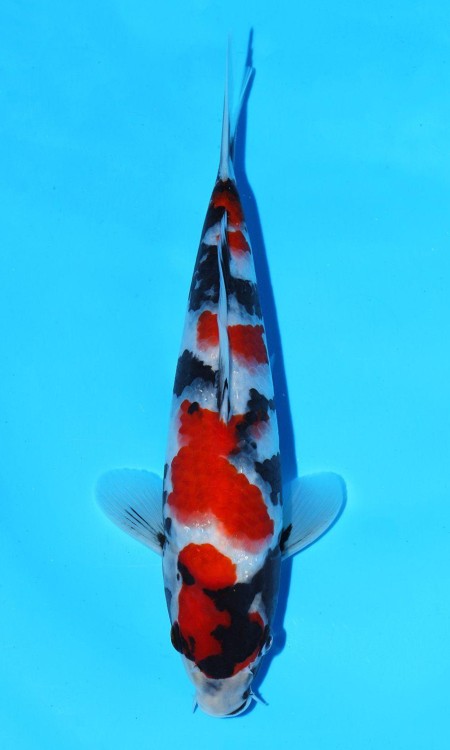
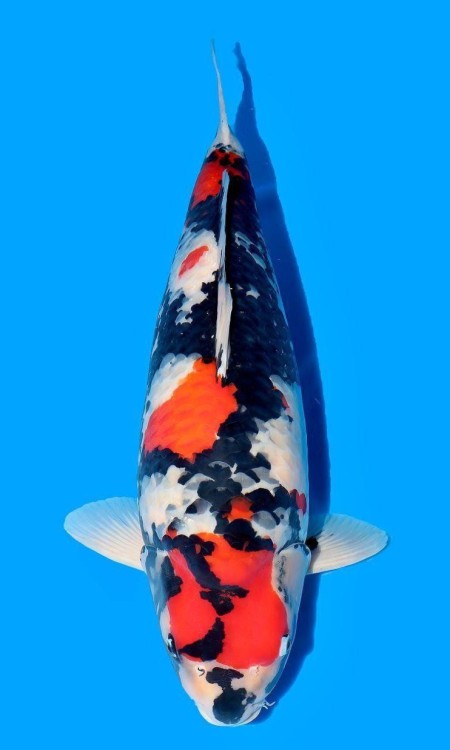
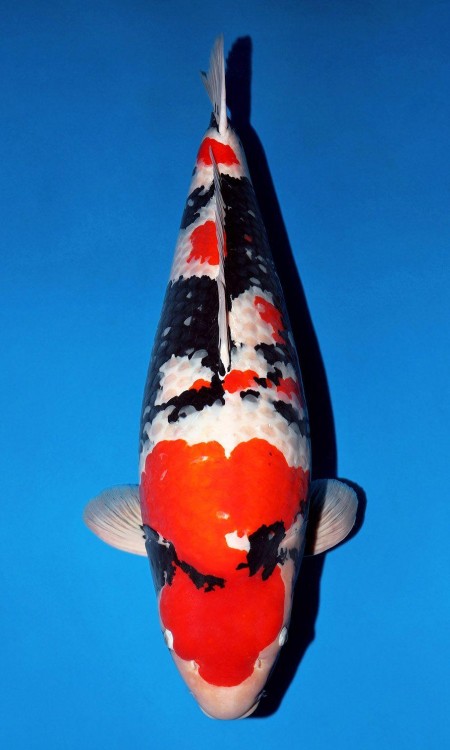
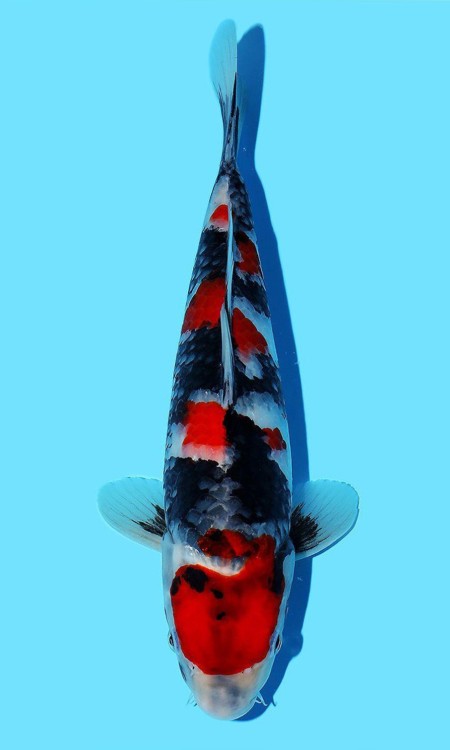
Award-winning reference photos
Identity
Showa Sanshoku is a three-color koi where black sumi can play a powerful structural role. Compared with Sanke, Showa often feels more dramatic and can show black on the head.
| Feature | Showa expectation | Beginner checkpoint |
|---|---|---|
| Sumi structure | Black should feel like part of the body pattern, often wrapping from below. | If black looks like small loose spots, compare carefully with Sanke. |
| Head pattern | Black on the head is acceptable and often important to Showa identity. | Do not reject all head sumi automatically. |
| Three-color balance | White, red, and black should all have a role without making the fish chaotic. | Stand back and judge the whole fish, not one dramatic sumi mark. |
| Development | Young Showa can change substantially as sumi rises or consolidates. | Ask for age, breeder, and development history when paying more. |
Showa or Sanke: use several clues together
| Check | Showa Sanshoku | Taisho Sanke |
|---|---|---|
| Base-color logic | Black base with red and white pattern. | White base with red pattern and separate black markings. |
| Sumi topology | Continuous utsuri-zumi often wraps upward and helps form the body pattern. | Glossy urushi-zumi is usually read as balanced, more isolated accents. |
| Head and fins | Head sumi, menware, and motoguro can support identification. | A cleaner head and lighter fin markings are useful clues. |
| Avoid this shortcut | Do not classify from head sumi or motoguro alone; combine base color, wrapping versus isolated sumi, and the whole pattern. | |
Definition source: All Japan Nishikigoi Promotion Association — Showa Sanshoku and Taisho Sanke.
Core terms
- Motoguro
- Black at the base of the pectoral fins. It is often associated with Showa and Utsuri appreciation.
- Menware
- A head-splitting black pattern sometimes admired in Showa when it improves the overall balance.
- Sumi development
- Black can change significantly as young Showa mature, so a future-looking eye matters.
Where Kindai Showa fits
Kindai Showa is best treated as a modern visual expression within Showa, often with a lighter, more open use of white. It is not presented as a separate base variety in the cited JAS Showa definition.
Do not classify it by a fixed white-percentage rule. A white-dominant koi can still be Showa when the underlying black-base logic and continuous, wrapping utsuri-zumi remain present. Use color area only after checking base color and sumi structure.
Reference boundary: All Japan Nishikigoi Promotion Association — Showa Sanshoku.
Beginner notes
- Look for a strong body first; dramatic pattern cannot fix poor structure.
- Balance between black, red, and white matters more than any single marking.
- Young Showa can change as black develops, so patience is part of the variety.
- When comparing with Sanke, ask whether black feels like part of the fish's structure rather than small accents.